This Bible study series uses simple words so everyone can understand and grow in faith. It is perfect for ESL students, homeschool children, families, and anyone who enjoys studying the Bible in easy English.
Copyright Notice: All lessons and printables on this website are protected by copyright. You are welcome to download and print them for free for personal use, small groups, or Bible classes. You may share a link to this page, but please do not sell these materials or copy this content to other websites.
Lesson Icebreaker Question
Have you ever received a piece of advice that really helped you make a good choice?
What was it?
Who gave it to you?
Lesson Highlight
In this lesson we will learn about the difference between living a wise life and a foolish life. We will discover how God wants us to use our words, work hard, and make choices that bring true peace!
Vocabulary Lists for the ERV Bible Translation
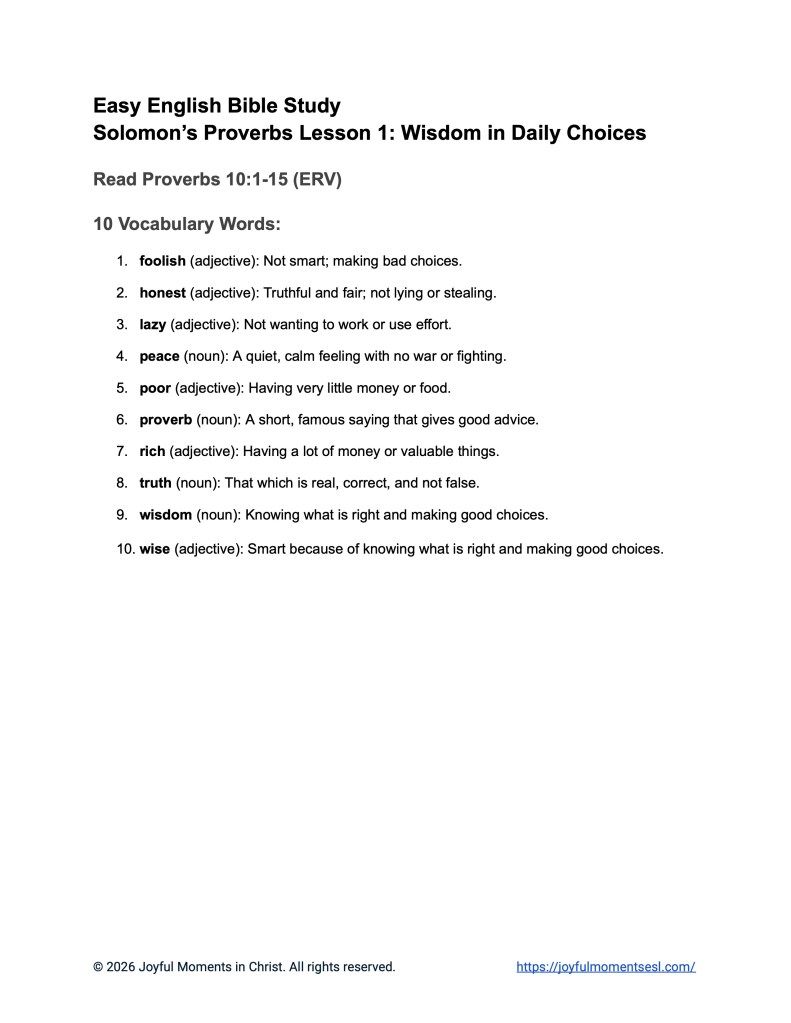
Key Vocabulary Words (10 words)
- foolish (adjective): Not smart; making bad choices.
- honest (adjective): Truthful and fair; not lying or stealing.
- lazy (adjective): Not wanting to work or use effort.
- peace (noun): A quiet, calm feeling with no war or fighting.
- poor (adjective): Having very little money or food.
- proverb (noun): A short, famous saying that gives good advice.
- rich (adjective): Having a lot of money or valuable things.
- truth (noun): That which is real, correct, and not false.
- wisdom (noun): Knowing what is right and making good choices.
- wise (adjective): Smart because of knowing what is right and making good choices.
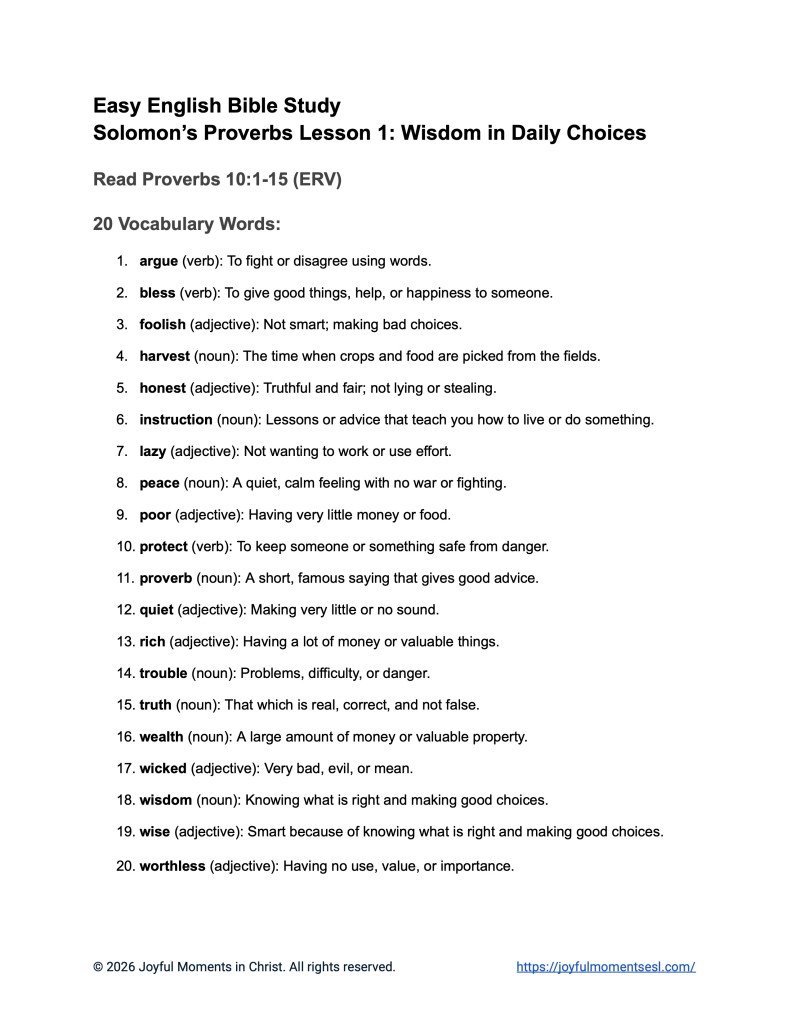
Important Words to Know (20 words)
- argue (verb): To fight or disagree using words.
- bless (verb): To give good things, help, or happiness to someone.
- foolish (adjective): Not smart; making bad choices.
- harvest (noun): The time when crops and food are picked from the fields.
- honest (adjective): Truthful and fair; not lying or stealing.
- instruction (noun): Lessons or advice that teach you how to live or do something.
- lazy (adjective): Not wanting to work or use effort.
- peace (noun): A quiet, calm feeling with no war or fighting.
- poor (adjective): Having very little money or food.
- protect (verb): To keep someone or something safe from danger.
- proverb (noun): A short, famous saying that gives good advice.
- quiet (adjective): Making very little or no sound.
- rich (adjective): Having a lot of money or valuable things.
- trouble (noun): Problems, difficulty, or danger.
- truth (noun): That which is real, correct, and not false.
- wealth (noun): A large amount of money or valuable property.
- wicked (adjective): Very bad, evil, or mean.
- wisdom (noun): Knowing what is right and making good choices.
- wise (adjective): Smart because of knowing what is right and making good choices.
- worthless (adjective): Having no use, value, or importance.
Complete Lesson Word Bank
- accept (verb): To take or agree to something that is given.
- argue (verb): To fight or disagree using words.
- arguments (noun): Angry disagreements between people.
- bless (verb): To give good things, help, or happiness to someone.
- caught (verb): Found, trapped, or held.
- cheaters (noun): People who do not follow the rules to get what they want.
- fail (verb): To not do what you should do, or to not succeed.
- foolish (adjective): Not smart; making bad choices.
- fools (noun): People who make silly or bad choices.
- forgotten (adjective): Not remembered by anyone.
- fresh (adjective): Clean, new, and good.
- gain (verb): To get or earn something.
- harvest (noun): The time when crops and food are picked from the fields.
- hatred (noun): A strong feeling of disliking someone or something very much.
- hide (verb): To keep something out of sight so others cannot see it.
- honest (adjective): Truthful and fair; not lying or stealing.
- instruction (noun): Lessons or advice that teach you how to live or do something.
- intelligent (adjective): Smart and able to learn quickly.
- lazy (adjective): Not wanting to work or use effort.
- lying (verb): Saying things that are not true.
- memories (noun): Things or people from the past that you remember.
- openly (adverb): Honestly and clearly, without trying to hide anything.
- overlooks (verb): Chooses to forgive or ignore a mistake.
- peace (noun): A quiet, calm feeling with no war or fighting.
- poor (adjective): Having very little money or food.
- poverty (noun): The state of being very poor.
- protect (verb): To keep someone or something safe from danger.
- proverb (noun): A short, famous saying that gives good advice.
- punish (verb): To make someone experience pain or trouble for doing wrong.
- quiet (adjective): Making very little or no sound.
- rich (adjective): Having a lot of money or valuable things.
- save (verb): To rescue someone from danger or harm.
- secure (adjective): Safe from danger or worry.
- sleep (verb): To rest your eyes and body, usually at night.
- spring (noun): A place where water comes naturally out of the ground.
- successful (adjective): Reaching a good goal after working hard.
- trouble (noun): Problems, difficulty, or danger.
- truth (noun): That which is real, correct, and not false.
- violent (adjective): Using force to hurt or destroy things.
- wealth (noun): A large amount of money or valuable property.
- wicked (adjective): Very bad, evil, or mean.
- wisdom (noun): Knowing what is right and making good choices.
- wise (adjective): Smart because of knowing what is right and making good choices.
- worthless (adjective): Having no use, value, or importance.
- wrongs (noun): Bad or unfair actions.
Summary of the Passage
In Proverbs 10:1-15, King Solomon shares many short sayings that compare two ways to live: the wise way and the foolish way. Solomon was a famous king of Israel. When God promised to give him whatever he asked for, Solomon asked for wisdom so he could lead the people well. God made him very wise!
In chapters 1–9, Solomon wrote long lessons about why wisdom is important. Now, starting in chapter 10, the book changes format to a list of short, practical proverbs to help us make good choices every day.
Solomon explains that our choices shape our whole lives and affect the people around us. Wise choices bring happiness to our parents, while foolish choices cause deep sadness. God also cares about how we work and handle money. Hard work leads to success and provides what we need, while laziness and getting money through cheating bring ruin. God protects and takes care of good people, but he stops evil plans.
Solomon also shows that wisdom changes how we use our words. Wise people stay quiet so they can listen and learn new things. When they speak, their words give fresh life to others and build peace. They show love by choosing to forgive mistakes instead of starting fights. Fools, on the other hand, talk too much, tell lies, and reject advice until their anger and arguments bring trouble on themselves.
Finally, Solomon teaches us about safety and lasting value. Lying cheaters will eventually be caught, but honest people can walk with peace and security. In this world, money can offer physical protection from hardship, but living God’s way gives true safety and leaves a wonderful memory that blesses others for a long time.
Read The Passage
Most English learners should use the Easy-to-Read Version (ERV), the New International Reader’s Version (NIRV), or the Good News Translation (GNT). If you want to try something harder, you can read one of the other Bible versions.
Solomon’s Proverbs
Proverbs 10:1-15 (ERV)
1 These are the proverbs of Solomon:
A wise son makes his father happy; a foolish one makes his mother sad.
2 Wealth gained by doing wrong will not really help you, but doing right will save you from death.
3 The Lord takes care of good people and gives them the food they need, but he keeps the wicked from getting what they want.
4 Lazy hands will make you poor; hard-working hands will make you rich.
5 A son who works hard while it is harvest time will be successful, but one who sleeps through the harvest is worthless.
6 People say good things about those who live right, but the words of the wicked only hide their violent plans.
7 Good people leave memories that bless us, but the wicked are soon forgotten.
8 The wise accept instruction, but fools argue and bring trouble on themselves.
9 Honest people can always feel secure, but lying cheaters will be caught.
10 If you fail to speak the truth, trouble will follow. If you speak openly, peace will come.
11 The words of good people are like a spring of fresh water, but the words of the wicked only hide their violent plans.
12 Hatred causes arguments, but love overlooks all wrongs.
13 Intelligent people speak words of wisdom, but fools must be punished before they learn their lesson.
14 Wise people are quiet and learn new things, but fools talk and bring trouble on themselves.
15 Wealth protects the rich, but poverty destroys the poor.
- Very Easy: Easy-to-Read Version: Proverbs 10:1-15 (ERV)
- Very Easy: New International Reader’s Version: Proverbs 10:1-15 (NIRV)
- Easy: Good News Translation: Proverbs 10:1-15 (GNT)
- Medium: New Living Translation: Proverbs 10:1-15 (NLT)
- Hard: New International Version: Proverbs 10:1-15 (NIV)
- Very Hard: English Standard Version: Proverbs 10:1-15 (ESV)
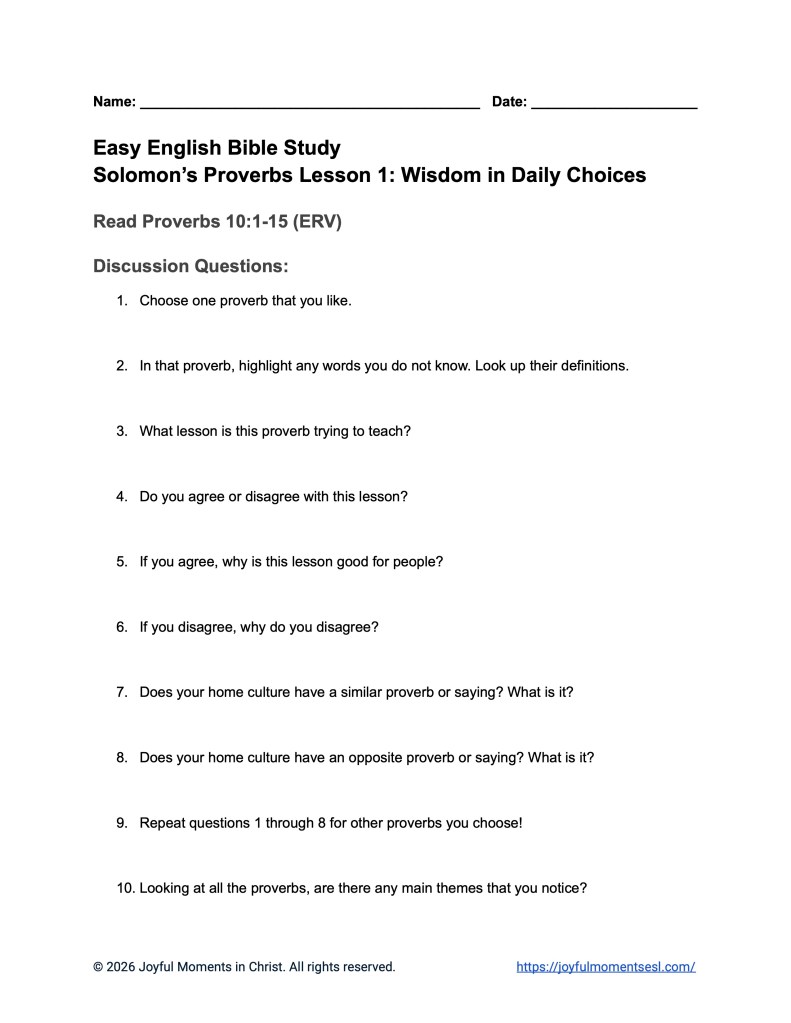
Discussion Questions
- Choose one proverb that you like.
- In that proverb, highlight any words you do not know. Look up their definitions.
- What lesson is this proverb trying to teach?
- Do you agree or disagree with this lesson?
- If you agree, why is this lesson good for people?
- If you disagree, why do you disagree?
- Does your home culture have a similar proverb or saying? What is it?
- Does your home culture have an opposite proverb or saying? What is it?
- Repeat questions 1 through 8 for other proverbs you choose!
- Looking at all the proverbs, are there any main themes that you notice?
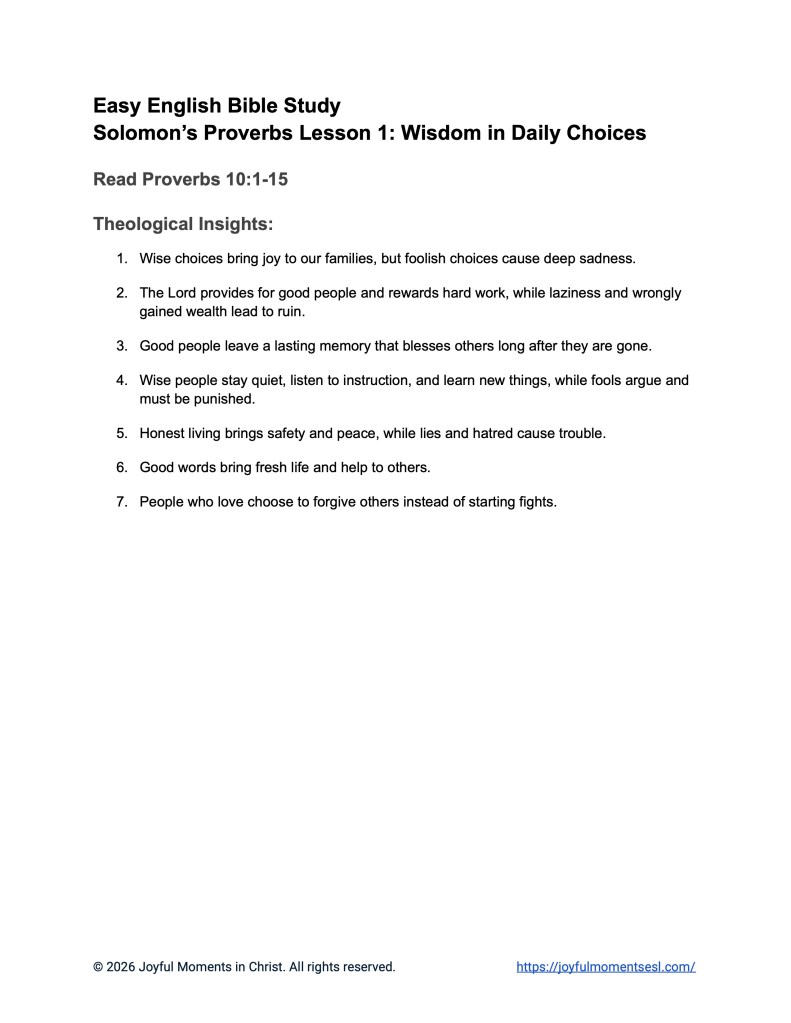
Theological Insights
- Wise choices bring joy to our families, but foolish choices cause deep sadness.
- The Lord provides for good people and rewards hard work, while laziness and wrongly gained wealth lead to ruin.
- Good people leave a lasting memory that blesses others long after they are gone.
- Wise people stay quiet, listen to instruction, and learn new things, while fools argue and must be punished.
- Honest living brings safety and peace, while lies and hatred cause trouble.
- Good words bring fresh life and help to others.
- People who love choose to forgive others instead of starting fights.
Closing Prayer
Dear Father,
You are great and full of wisdom.
We are sorry for the times we use mean words and act lazy.
Thank you for giving us the Bible to show us how to live.
Please help us make wise choices that make you happy today.
In Jesus’ name we pray.
Amen.
Worksheets
- Printable ERV Bible Passage
- Complete Set of Printable Worksheets
- Discussion Questions
- Theological Insights
- 10- Word Vocabulary List
- 20- Word Vocabulary List
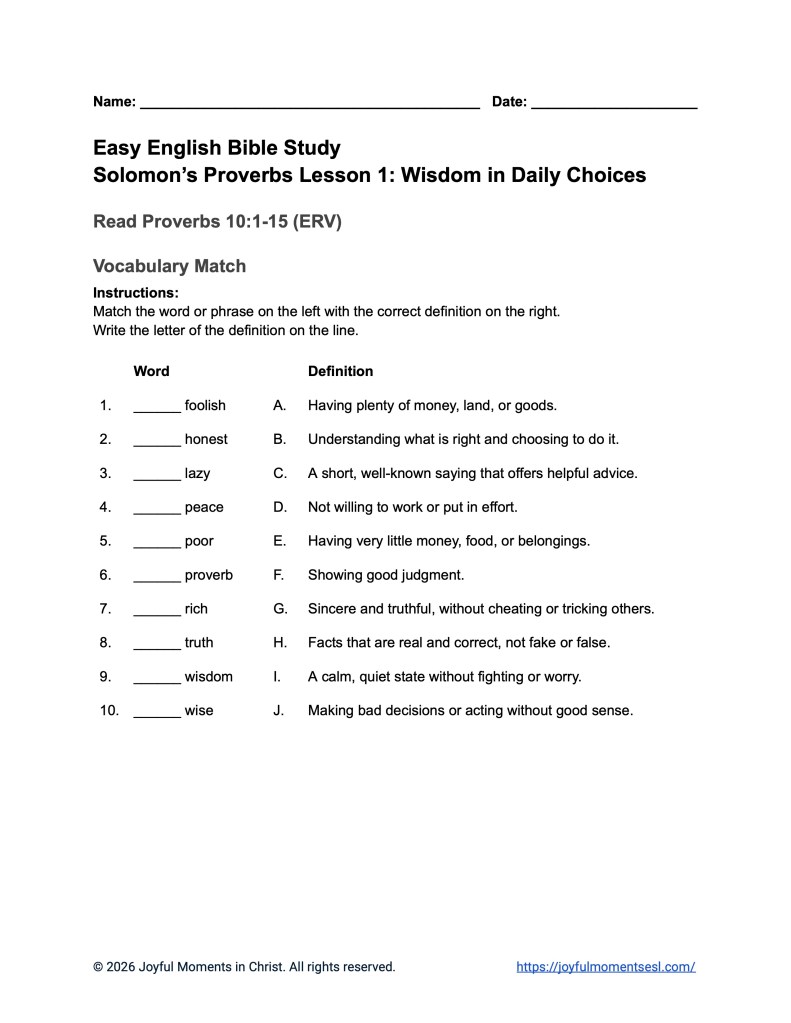
- Vocabulary Match Worksheet
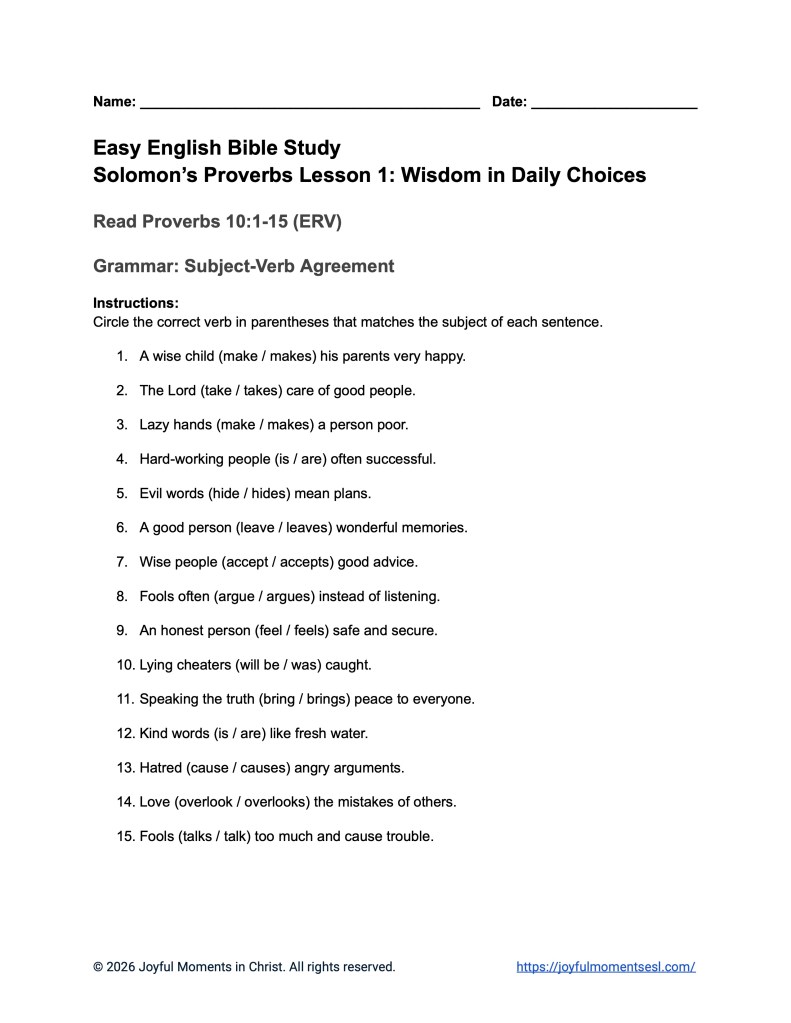
- Grammar Practice Worksheet
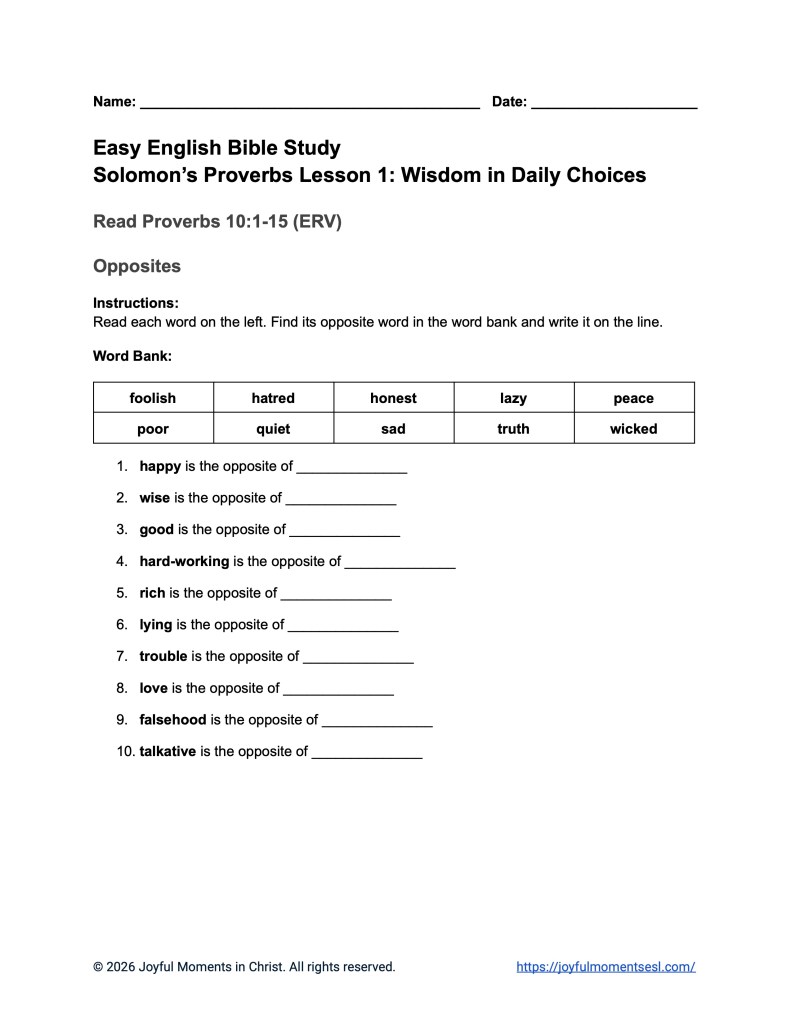
- Opposites Worksheet
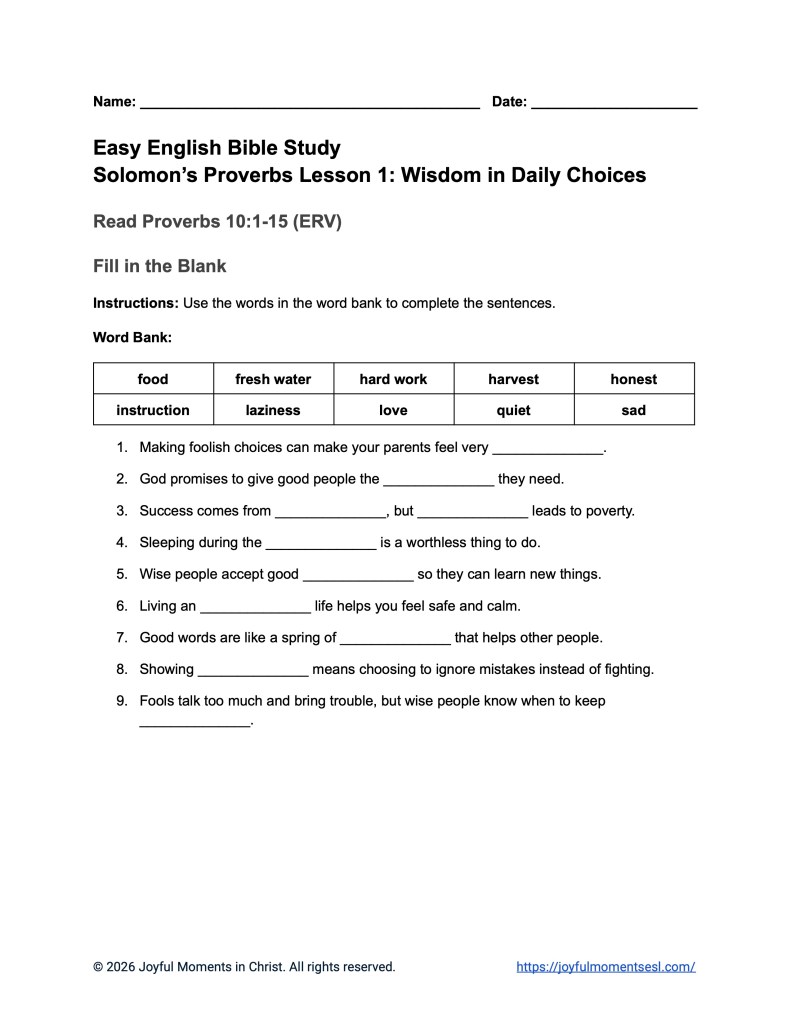
- Fill in the Blank Worksheet
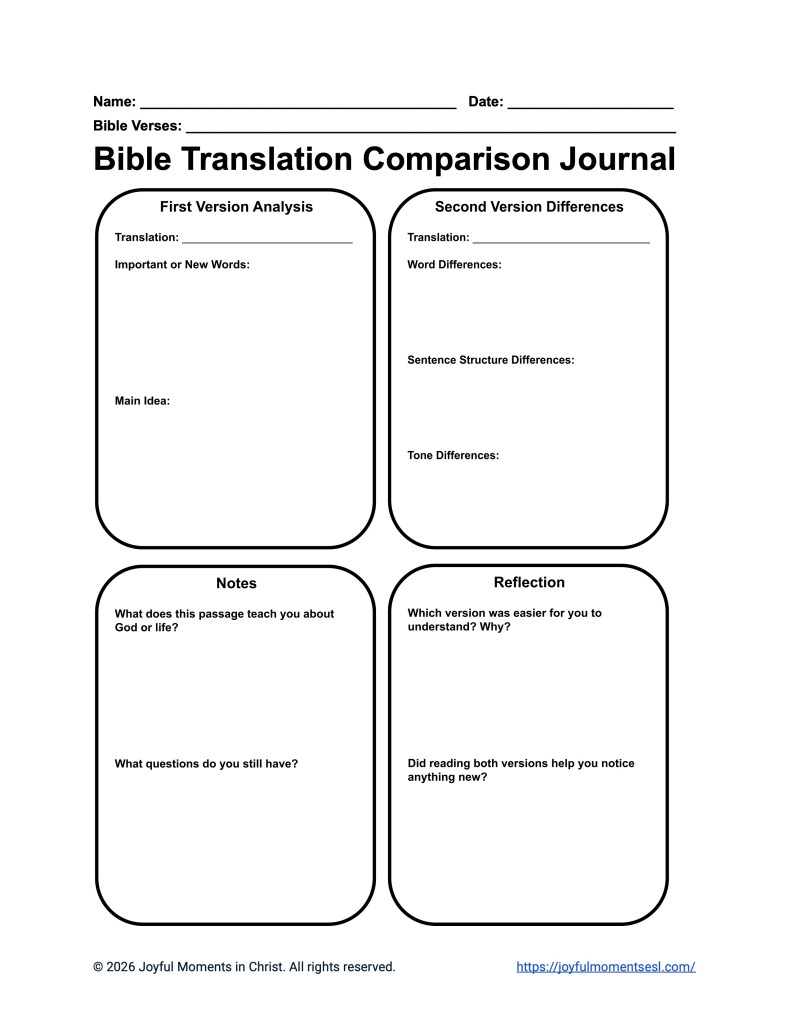
- Bible Translation Comparison Journal
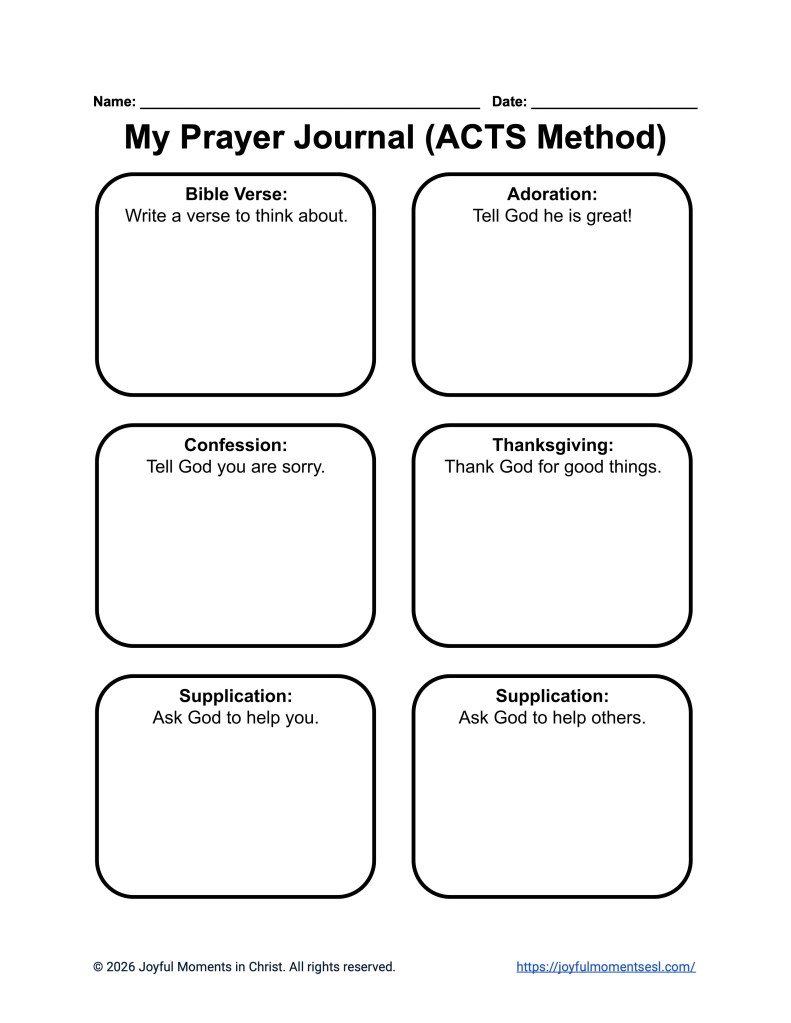
- Prayer Journal
- Answer Keys
Respond
Which proverb from this passage gave you the best advice for your life today? Why?
Write your answer in the comments below!
Solomon’s Proverbs Bible Study Series
I am starting a new Bible study series on Solomon’s Proverbs in Proverbs 10 through Proverbs 22:16!
These Bible lessons are great for ESL students, homeschool children, families, and anyone who enjoys easy English and wants to grow their faith.
More Easy English Resources
More Related Resources
Visit the Joyful Moments ESL homepage for all posts, or scroll through other Bible studies:
Something went wrong. Please refresh the page and/or try again.
Scripture quotations marked (ERV) are taken from the HOLY BIBLE: EASY-TO-READ VERSION ©2006 by Bible League International. Used by permission.


Leave a comment