
An idiom is a group of words with a special meaning that is different from the literal meaning of each single word. Many everyday English phrases come straight from the Bible, especially from older translations like the King James Version (KJV). Learning these phrases is a great way to build vocabulary for ESL students, homeschool children, and anyone who wants to learn English with the Bible!
Copyright Notice: All lessons and printables on this website are protected by copyright. You are welcome to download and print them for free for personal use, small groups, or Bible classes. You may share a link to this page, but please do not sell these materials or copy this content to other websites.
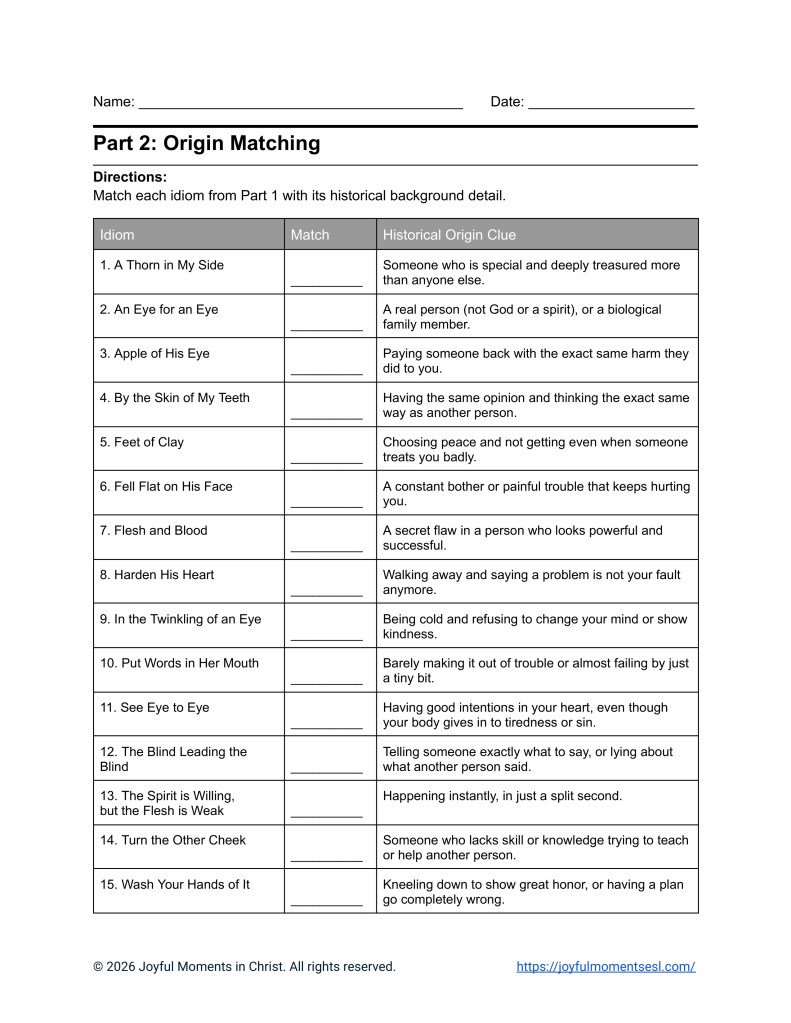
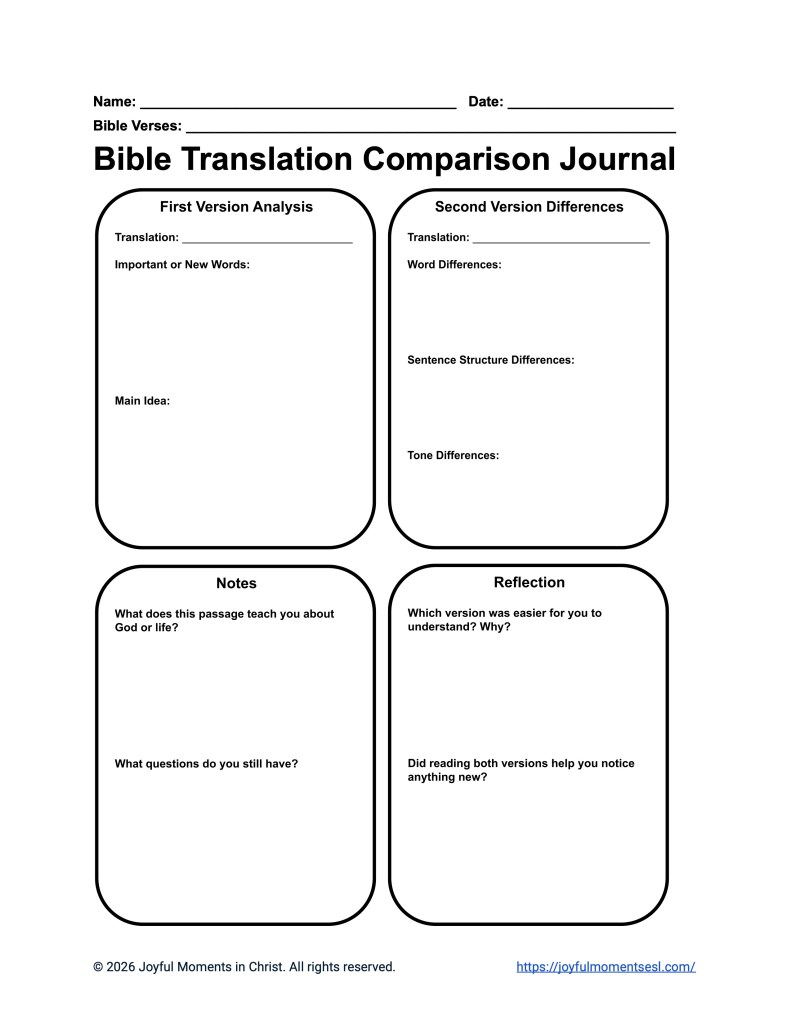
In this guide, I will show two different Bible translations for each idiom. The English Standard Version (ESV) keeps many of the classic English words and body-part metaphors that are in earlier translations. The Easy-to-Read Version (ERV) translates the meaning of ancient idioms into clear, simple English so anyone can understand them right away.
Body Part Idioms
Here are a few body part idioms that we will look at:
- A Thorn in the Flesh / A Thorn in My Side
- An Eye for an Eye
- Apple of His Eye
- By the Skin of My Teeth
- Feet of Clay
- Fell Flat on His Face
- Flesh and Blood
- Harden His Heart
- In the Twinkling of an Eye
- Put Words in Her Mouth
- See Eye to Eye
- The Blind Leading the Blind
- The Spirit is Willing, but the Flesh is Weak
- Turn the Other Cheek
- Wash Your Hands of It
1. A Thorn in the Flesh / A Thorn in My Side
Simple Meaning:
An ongoing pain or annoying problem that will not go away.
Where to Find It in the Bible:
- Numbers 33:55 (ERV): “You must force these other people to leave the country. If you let them stay in your country, they will bring many troubles to you. They will be like a needle in your eye and a thorn in your side. They will bring many troubles to the country where you will be living.”
- Numbers 33:55 (ESV): “But if you do not drive out the inhabitants of the land from before you, then those of them whom you let remain shall be as barbs in your eyes and thorns in your sides, and they shall trouble you in the land where you dwell.”
- 2 Corinthians 12:7 (ERV): “But I must not be too proud of the wonderful things that were shown to me. So a painful problem was given to me—an angel from Satan, sent to make me suffer, so that I would not think that I am better than anyone else.”
- 2 Corinthians 12:7 (ESV): “So to keep me from becoming conceited because of the surpassing greatness of the revelations, a thorn was given me in the flesh, a messenger of Satan to harass me, to keep me from becoming conceited.”
Origin & Context:
Both versions of this idiom come directly from the Bible. In Numbers 33:55, Moses warned the Israelites that leaving enemies in the land would bring constant trouble, like “a thorn in your side” (ERV) or “thorns in your sides” (ESV). Centuries later, the Apostle Paul wrote in 2 Corinthians 12:7 that God allowed him to suffer from a painful, ongoing struggle to keep him humble, which the ESV calls “a thorn…in the flesh” and the ERV explains simply as “a painful problem.”
Examples in Everyday English:
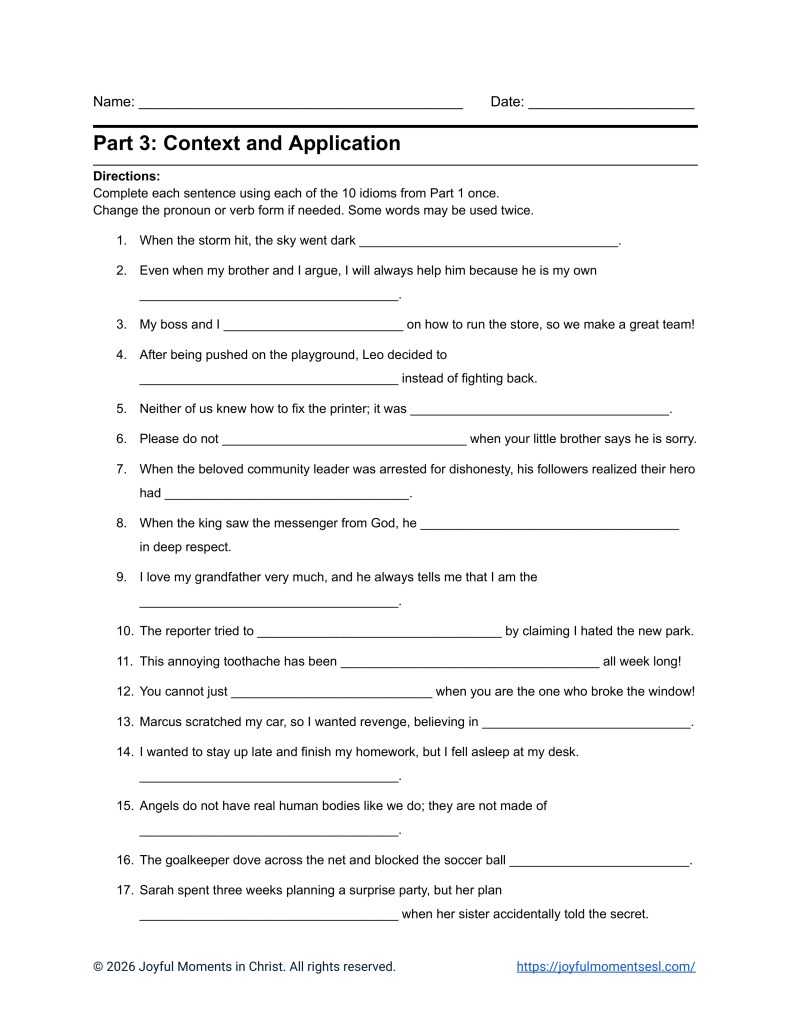
- That noisy neighbor has been a thorn in my side all summer.
- My sore knee is a thorn in the flesh when I try to run.
- Our old computer is a constant thorn in our side at work.
2. An Eye for an Eye
Simple Meaning:
A punishment that matches the exact harm someone caused.
Where to Find It in the Bible:
- Exodus 21:24 (ERV): “You must trade an eye for an eye, a tooth for a tooth, a hand for a hand, a foot for a foot.”
- Exodus 21:24 (ESV): “Eye for eye, tooth for tooth, hand for hand, foot for foot”
- Matthew 5:38 (ERV): “You have heard that it was said, ‘An eye for an eye, and a tooth for a tooth.’”
- Matthew 5:38 (ESV): “You have heard that it was said, ‘An eye for an eye and a tooth for a tooth.’”
Origin & Context:
The “eye for an eye” law meant that a punishment had to match the crime. A person who caused an injury would receive that exact same injury in return. Before Moses wrote it down in Exodus, similar laws already existed in ancient Near Eastern cultures, such as the Code of Hammurabi. In the Old Testament, God gave this law to judges to make sure punishments were fair and did not go too far. Later, in the Sermon on the Mount, Jesus taught his followers not to take personal revenge, even if someone hurts them.
Examples in Everyday English:
- If we always demand an eye for an eye, the fighting will never stop.
- He wanted an eye for an eye after his brother broke his favorite toy.
- Modern courts do not usually follow a strict eye-for-an-eye rule.
3. By the Skin of My Teeth
Simple Meaning:
Escaping danger or failure by the smallest possible amount.
Where to Find It in the Bible:
- Job 19:20 (ERV): “I am so thin, my skin hangs loose on my bones. I have little life left in me.“
- Job 19:20 (ESV): “My bones stick to my skin and to my flesh, and I have escaped by the skin of my teeth.”
Origin & Context:
This phrase originated in the Bible. Job lost his children, his wealth, and his health, leaving him near death. Teeth do not actually have skin, so Job used this strange picture to show he had almost nothing left and barely survived his terrible suffering. While the ESV keeps the exact idiom, the ERV leaves out the teeth metaphor and describes Job’s weak, thin body instead.
Examples in Everyday English:
- We ran through the airport and caught our flight by the skin of our teeth.
- He studied all night and passed the math test by the skin of his teeth.
- The deer jumped out of the road and missed the car by the skin of its teeth.
4. Feet of Clay
Simple Meaning:
A hidden weakness in someone who seems strong and important.
Where to Find It in the Bible:
- Daniel 2:33 (ERV): “The lower part of the legs was made from iron. Its feet were made partly of iron and partly of clay.”
- Daniel 2:33 (ESV): “Its legs of iron, its feet partly of iron and partly of clay.”
Origin & Context:
This idiom comes from the Bible. King Nebuchadnezzar had a dream about a giant, shiny statue with a head of gold and legs of strong iron. However, its feet were mixed with weak clay. A stone hit the weak feet, and the whole giant statue crashed down, showing that even great rulers have weak spots.
Examples in Everyday English:
- Many famous leaders turn out to have feet of clay when we learn about their private lives.
- The company looked rich on the outside, but it had feet of clay and soon went out of business.
- Even our greatest heroes are human and have feet of clay.
5. Fell Flat on His Face
Simple Meaning:
To bow down low in deep respect, or to fail completely.
Where to Find It in the Bible:
- Numbers 22:31 (ERV): “Then the Lord allowed Balaam to see the angel. The Lord’s angel was standing in the road, holding a sword in his hand. Balaam bowed low to the ground.”
- Numbers 22:31 (ESV): “Then the Lord opened the eyes of Balaam, and he saw the angel of the Lord standing in the way, with his drawn sword in his hand. And he bowed down and fell on his face.”
- Numbers 22:31 (KJV): “Then the Lord opened the eyes of Balaam, and he saw the angel of the Lord standing in the way, and his sword drawn in his hand: and he bowed down his head, and fell flat on his face.”
Origin & Context:
This phrase comes from the Bible, with the exact wording “fell flat on his face” coming from the King James Version (KJV). A prophet named Balaam was riding his donkey when the Lord opened his eyes to see an angel blocking the road with a drawn sword. Terrified and full of respect, Balaam dropped straight to the ground with his face down. Today, people don’t often use this phrase to show deep respect. Instead, they mostly use it when a plan fails badly.
Examples in Everyday English:
- I tried to tell a funny joke, but it fell flat on its face and nobody laughed. (failure)
- She tripped over the rug and fell flat on her face in the hallway. (failure)
- Their plan to sell winter coats in July fell flat on its face. (failure)
- When my son was arrested, I fell flat on my face and prayed to God for help. (respect)
6. Flesh and Blood
Simple Meaning:
A real human being, rather than God or a spirit, or a close blood relative.
Where to Find It in the Bible:
- Matthew 16:17 (ERV): “Jesus answered, ‘You are blessed, Simon son of Jonah. No one taught you that. My Father in heaven showed you who I am.’”
- Matthew 16:17 (ESV): “And Jesus answered him, ‘Blessed are you, Simon Bar-Jonah! For flesh and blood has not revealed this to you, but my Father who is in heaven.’”
Origin & Context:
While ancient Jewish writers also used this phrase, it became popular in English through the Bible. When Peter declared that Jesus was the Messiah, Jesus explained that no ordinary human (“flesh and blood” in the ESV, or “no one” in the ERV) could have taught Peter that truth. Only God the Father showed it to him. Today, people also use “flesh and blood” to talk about their close family members who are related by genetics.
Examples in Everyday English:
- Seeing the old photos reminded me that my grandparents were real flesh and blood people. (human)
- I cannot forgive him easily because I am only flesh and blood. (human)
- She loves her adopted son just as much as her own flesh and blood. (genetic family member)
7. Harden His Heart
Simple Meaning:
To become stubborn and refuse to listen or care.
Where to Find It in the Bible:
- Exodus 4:21 (ERV): “While Moses was traveling back to Egypt, the Lord spoke to him, ‘When you talk to Pharaoh remember to show him all the miracles that I have given you the power to do. But I will cause Pharaoh to be very stubborn. He will not let the people go.’”
- Exodus 4:21 (ESV): “And the Lord said to Moses, ‘When you go back to Egypt, see that you do before Pharaoh all the miracles that I have put in your power. But I will harden his heart, so that he will not let the people go.’”
Origin & Context:
This phrase originated in the Bible. In ancient Hebrew thought, the heart was the center of a person’s mind and choices, not just feelings. When Pharaoh refused to free the Israelite slaves even after seeing mighty miracles, his stubbornness was described as a hard heart that nothing could soften, which the ERV translates plainly as “very stubborn.”
Examples in Everyday English:
- Do not harden your heart when a friend asks you for forgiveness.
- Years of living alone on the streets had hardened his heart toward strangers.
- She refused to harden her heart even after people treated her unfairly.
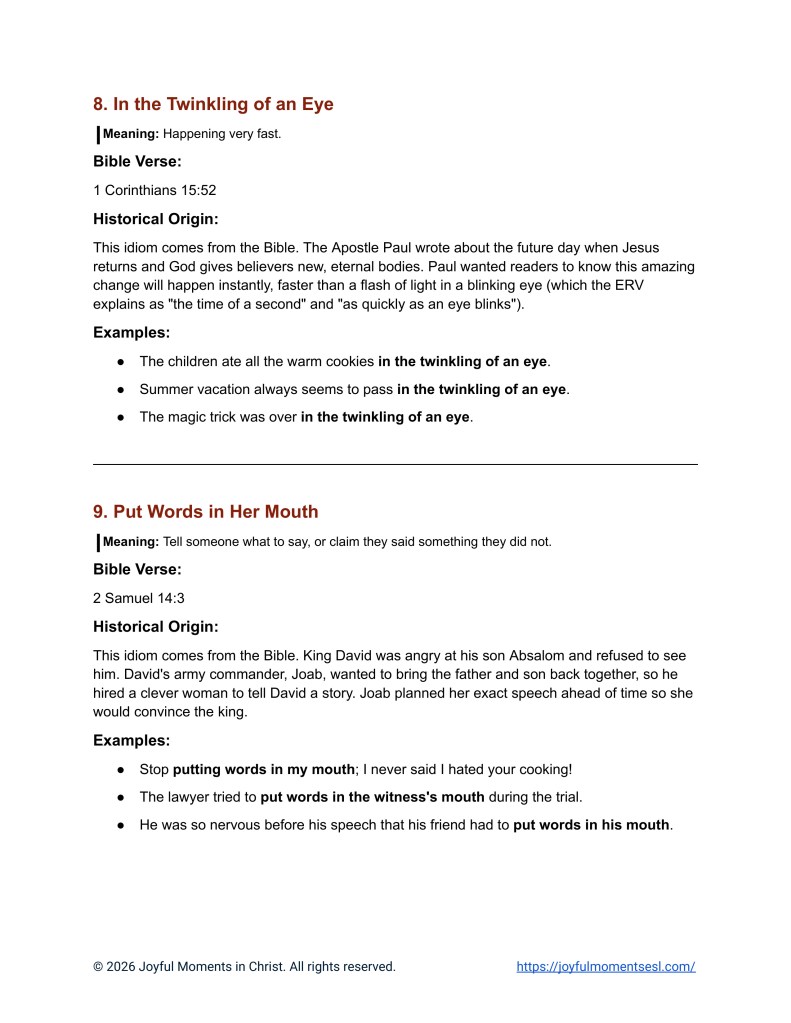
8. In the Twinkling of an Eye
Simple Meaning:
Happening very fast.
Where to Find It in the Bible:
- 1 Corinthians 15:52 (ERV): “It will only take the time of a second. We will be changed as quickly as an eye blinks. This will happen when the last trumpet blows. The trumpet will blow and those who have died will be raised to live forever. And we will all be changed.”
- 1 Corinthians 15:52 (ESV): “In a moment, in the twinkling of an eye, at the last trumpet. For the trumpet will sound, and the dead will be raised imperishable, and we shall be changed.”
Origin & Context:
This idiom comes from the Bible. The Apostle Paul wrote about the future day when Jesus returns and God gives believers new, eternal bodies. Paul wanted readers to know this amazing change will happen instantly, faster than a flash of light in a blinking eye (which the ERV explains as “the time of a second” and “as quickly as an eye blinks”).
Examples in Everyday English:
- The children ate all the warm cookies in the twinkling of an eye.
- Summer vacation always seems to pass in the twinkling of an eye.
- The magic trick was over in the twinkling of an eye.
9. Put Words in Her Mouth
Simple Meaning:
Tell someone what to say, or claim they said something they did not.
Where to Find It in the Bible:
- 2 Samuel 14:3 (ERV): “‘Go to the king and talk to him using these words that I tell you.’ Then Joab told the wise woman what to say.”
- 2 Samuel 14:3 (ESV): “‘Go to the king and speak thus to him.’ So Joab put the words in her mouth.”
Origin & Context:
This idiom comes from the Bible. King David was angry at his son Absalom and refused to see him. David’s army commander, Joab, wanted to bring the father and son back together, so he hired a clever woman to tell David a story. Joab planned her exact speech ahead of time so she would convince the king.
Examples in Everyday English:
- Stop putting words in my mouth; I never said I hated your cooking!
- The lawyer tried to put words in the witness’s mouth during the trial.
- He was so nervous before his speech that his friend had to put words in his mouth.
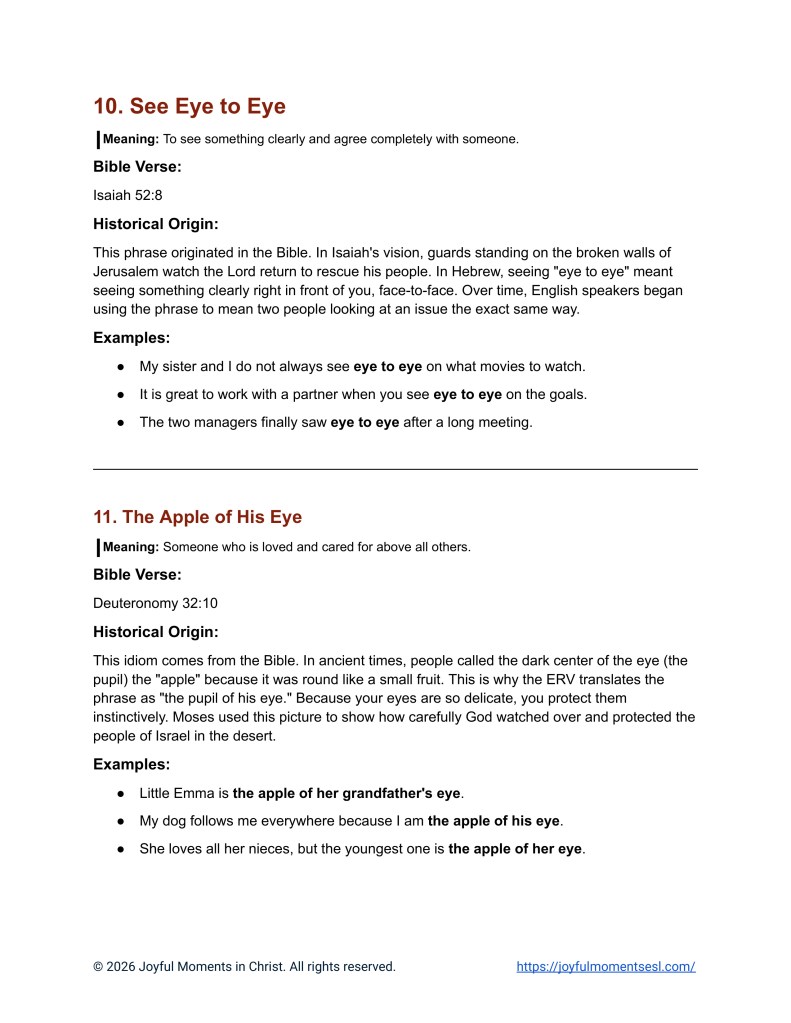
10. See Eye to Eye
Simple Meaning:
To see something clearly and agree completely with someone.
Where to Find It in the Bible:
- Isaiah 52:8 (ERV): “The city guards are shouting. They are all rejoicing together. They can all see the Lord returning to Zion.”
- Isaiah 52:8 (ESV): “The voice of your watchmen—they lift up their voice; together they sing for joy; for eye to eye they see the return of the Lord to Zion.”
Origin & Context:
This phrase originated in the Bible. In Isaiah’s vision, guards standing on the broken walls of Jerusalem watch the Lord return to rescue his people. In Hebrew, seeing “eye to eye” meant seeing something clearly right in front of you, face-to-face. Over time, English speakers began using the phrase to mean two people looking at an issue the exact same way.
Examples in Everyday English:
- My sister and I do not always see eye to eye on what movies to watch.
- It is great to work with a partner when you see eye to eye on the goals.
- The two managers finally saw eye to eye after a long meeting.
11. The Apple of His Eye
Simple Meaning:
Someone who is loved and cared for above all others.
Where to Find It in the Bible:
- Deuteronomy 32:10 (ERV): “The Lord found them in the desert, in an empty, windy land. He surrounded them and watched over them. He protected them like the pupil of his eye.”
- Deuteronomy 32:10 (ESV): “He found him in a desert land, and in the howling waste of the wilderness; he encircled him, he cared for him, he kept him as the apple of his eye.”
Origin & Context:
This idiom comes from the Bible. In ancient times, people called the dark center of the eye (the pupil) the “apple” because it was round like a small fruit. This is why the ERV translates the phrase as “the pupil of his eye.” Because your eyes are so delicate, you protect them instinctively. Moses used this picture to show how carefully God watched over and protected the people of Israel in the desert.
Examples in Everyday English:
- Little Emma is the apple of her grandfather’s eye.
- My dog follows me everywhere because I am the apple of his eye.
- She loves all her nieces, but the youngest one is the apple of her eye.
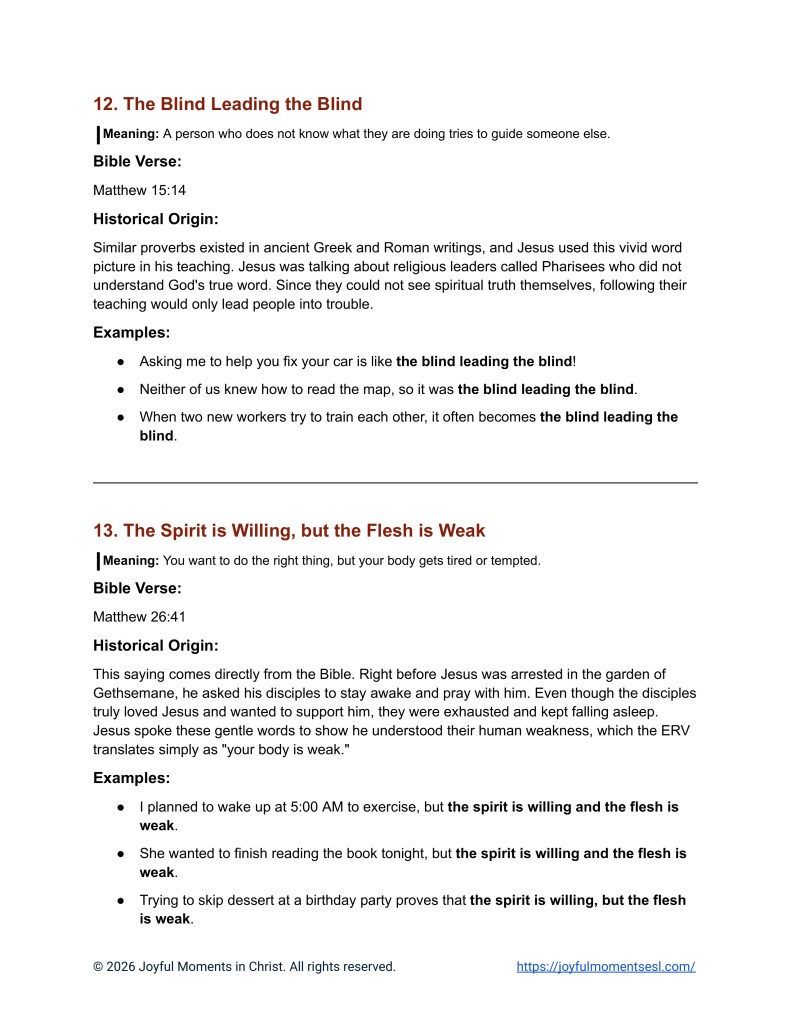
12. The Blind Leading the Blind
Simple Meaning:
A person who does not know what they are doing tries to guide someone else.
Where to Find It in the Bible:
- Matthew 15:14 (ERV): “Stay away from the Pharisees. They lead the people, but they are like blind men leading other blind men. And if a blind man leads another blind man, both of them will fall into a ditch.”
- Matthew 15:14 (ESV): “Let them alone; they are blind guides. And if the blind lead the blind, both will fall into a pit.”
Origin & Context:
Similar proverbs existed in ancient Greek and Roman writings, and Jesus used this vivid word picture in his teaching. Jesus was talking about religious leaders called Pharisees who did not understand God’s true word. Since they could not see spiritual truth themselves, following their teaching would only lead people into trouble.
Examples in Everyday English:
- Asking me to help you fix your car is like the blind leading the blind!
- Neither of us knew how to read the map, so it was the blind leading the blind.
- When two new workers try to train each other, it often becomes the blind leading the blind.
13. The Spirit is Willing, but the Flesh is Weak
Simple Meaning:
You want to do the right thing, but your body gets tired or tempted.
Where to Find Itin the Bible:
- Matthew 26:41 (ERV): “Stay awake and pray for strength against temptation. Your spirit wants to do what is right, but your body is weak.“
- Matthew 26:41 (ESV): “Watch and pray that you may not enter into temptation. The spirit indeed is willing, but the flesh is weak.“
Origin & Context:
This saying comes directly from the Bible. Right before Jesus was arrested in the garden of Gethsemane, he asked his disciples to stay awake and pray with him. Even though the disciples truly loved Jesus and wanted to support him, they were exhausted and kept falling asleep. Jesus spoke these gentle words to show he understood their human weakness, which the ERV translates simply as “your body is weak.”
Examples in Everyday English:
- I planned to wake up at 5:00 AM to exercise, but the spirit is willing and the flesh is weak.
- She wanted to finish reading the book tonight, but the spirit is willing and the flesh is weak.
- Trying to skip dessert at a birthday party proves that the spirit is willing, but the flesh is weak.
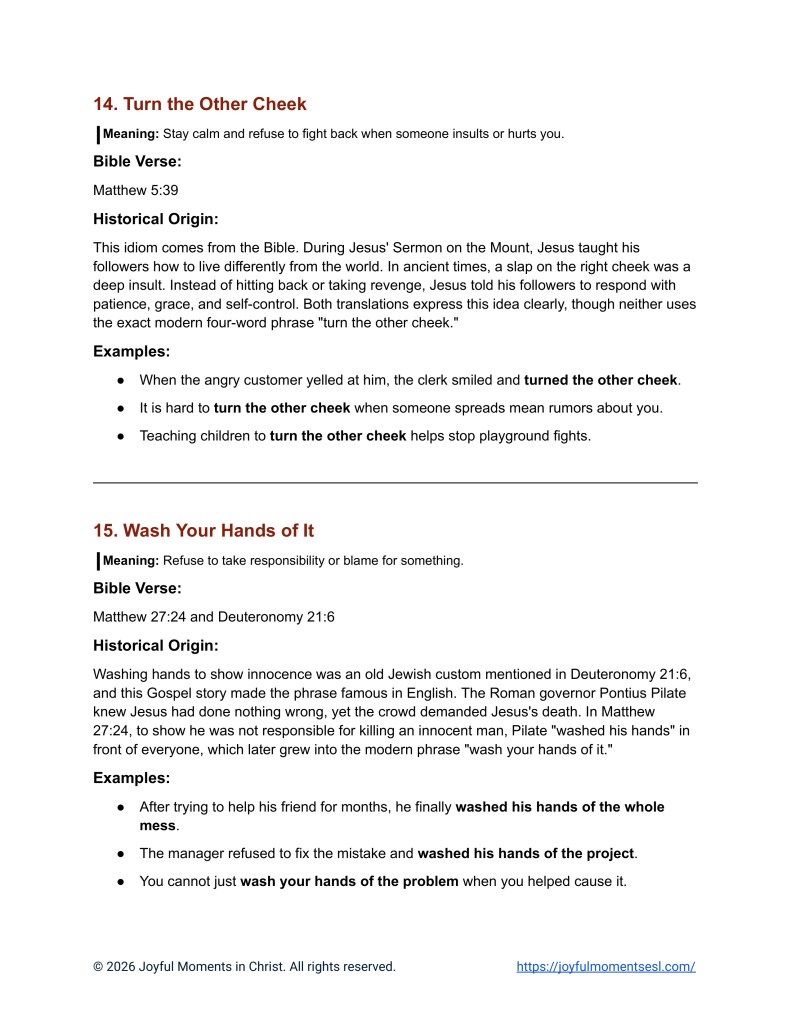
14. Turn the Other Cheek
Simple Meaning:
Stay calm and refuse to fight back when someone insults or hurts you.
Where to Find It in the Bible:
- Matthew 5:39 (ERV): “But I tell you, don’t fight back against someone who wants to do harm to you. If they hit you on the right cheek, let them hit the other cheek too.”
- Matthew 5:39 (ESV): “But I say to you, Do not resist the one who is evil. But if anyone slaps you on the right cheek, turn to him the other also.”
Origin & Context:
This idiom comes from the Bible. During Jesus’ Sermon on the Mount, Jesus taught his followers how to live differently from the world. In ancient times, a slap on the right cheek was a deep insult. Instead of hitting back or taking revenge, Jesus told his followers to respond with patience, grace, and self-control. Both translations express this idea clearly, though neither uses the exact modern four-word phrase “turn the other cheek.”
Examples in Everyday English:
- When the angry customer yelled at him, the clerk smiled and turned the other cheek.
- It is hard to turn the other cheek when someone spreads mean rumors about you.
- Teaching children to turn the other cheek helps stop playground fights.
15. Wash Your Hands of It
Simple Meaning:
Refuse to take responsibility or blame for something.
Where to Find It in the Bible:
- Matthew 27:24 (ERV): “Pilate saw that there was nothing he could do to make the people change. In fact, it looked as if there would be a riot. So he took some water and washed his hands in front of them all. He said, ‘I am not guilty of this man’s death. You are the ones who are doing it!’”
- Matthew 27:24 (ESV): “So when Pilate saw that he was gaining nothing, but rather that a riot was beginning, he took water and washed his hands before the crowd, saying, ‘I am innocent of this man’s blood; see to it yourselves.’”
- Deuteronomy 21:6 (ERV): “All the leaders of the town nearest the dead body must wash their hands over the cow that had its neck broken in the valley.”
- Deuteronomy 21:6 (ESV): “And all the elders of that city nearest to the slain man shall wash their hands over the heifer whose neck was broken in the valley.”
Origin & Context:
Washing hands to show innocence was an old Jewish custom mentioned in Deuteronomy 21:6, and this Gospel story made the phrase famous in English. The Roman governor Pontius Pilate knew Jesus had done nothing wrong, yet the crowd demanded Jesus’s death. In Matthew 27:24, to show he was not responsible for killing an innocent man, Pilate “washed his hands” in front of everyone, which later grew into the modern phrase “wash your hands of it.”
Examples in Everyday English:
- After trying to help his friend for months, he finally washed his hands of the whole mess.
- The manager refused to fix the mistake and washed his hands of the project.
- You cannot just wash your hands of the problem when you helped cause it.
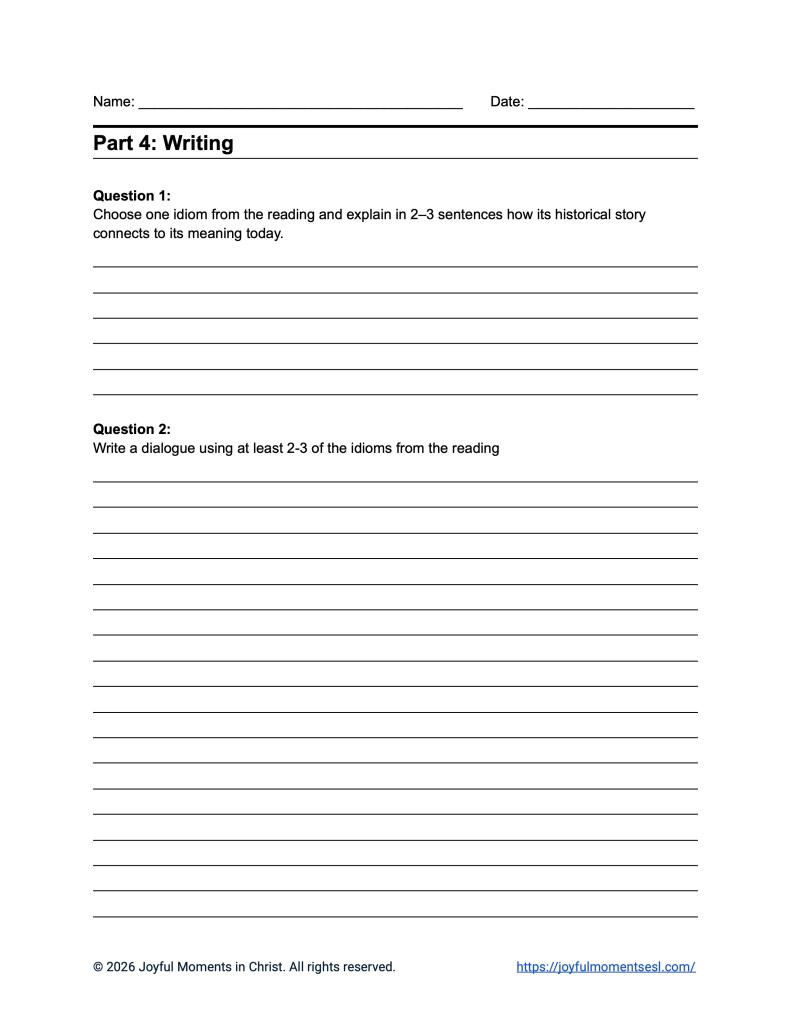
The Bible has shaped the English language in amazing ways! Listen for these 15 body-part idioms when you read books, watch shows, or talk with friends. Try picking one or two of your favorite phrases, then use them in a sentence today!

More Easy English Resources
More Related Resources
Visit the Joyful Moments ESL homepage for all posts, or scroll through more blog posts related to Bible Study:




Something went wrong. Please refresh the page and/or try again.
Scripture quotations marked (ERV) are taken from the HOLY BIBLE: EASY-TO-READ VERSION ©2006 by Bible League International. Used by permission.
Scripture quotations marked (ESV) are from the ESV® Bible (The Holy Bible, English Standard Version®), © 2001 by Crossway, a publishing ministry of Good News Publishers. Used by permission. All rights reserved. The ESV text may not be quoted in any publication made available to the public by a Creative Commons license. The ESV may not be translated in whole or in part into any other language.
Scripture quotations marked (KJV) are taken from the King James Bible public domain.




Leave a Reply